
Why Is Crypto Crashing?
Updated June 2026 · Educational market context, not financial advice

Crypto is crashing for the same handful of reasons it always does — too much borrowed money getting flushed out, sentiment flipping from greed to fear, and the wider money tide going out. The specific headline changes every time. The underlying mechanics almost never do. And historically, crashes have been a phase of the cycle, not the end of it — though no recovery is ever guaranteed.
If you typed "why is crypto crashing" into Google in the middle of a sell-off, you're in good company — that search spikes every single time the market dips, which tells you something: the panic is a recurring feature, not a unique emergency. The news will hand you a fresh villain each time (a big seller, an ETF outflow, a scary macro headline). Useful to know, but those are the triggers. The reasons a crash gathers speed are structural, and they're worth understanding once so you stop re-panicking every time.
Quick honesty up front: nothing here is financial advice — it's educational context for your own research.
What's actually happening when crypto "crashes"?
First, a definition, because "crash" gets thrown at everything from a bad afternoon to a year-long bear market. A real crash is a fast, broad, high-volume drop — not one coin wobbling, but the whole market sliding together while the mood turns from confident to scared. A 10% dip on a Tuesday is just crypto being crypto. A crash is when the selling feeds on itself.
That self-feeding part is the key. In a normal pullback, buyers step in. In a crash, falling prices create more selling — forced liquidations, stop-losses, and plain fear all push the same direction at once. That's why crashes feel violent and disorienting: it's not one thing going wrong, it's several feedback loops firing together.
The real reasons crypto crashes
Strip away the day's specific headline and almost every crypto crash runs on the same few engines. Usually more than one at the same time:
- Too much borrowed money (leverage). When lots of traders are using borrowed funds to bet on higher prices, a modest dip can trigger forced liquidations — their positions get automatically sold off. That selling pushes price lower, which triggers more liquidations, and a cascade is born. This is the single biggest reason crashes accelerate so fast.
- Sentiment flips. Crypto runs on belief. When confidence cracks, the same crowd that bought every dip suddenly sells every bounce. Greed becomes fear almost overnight, and fear is contagious.
- The macro tide goes out. Crypto doesn't trade in a vacuum. When interest rates rise, liquidity tightens, or risk appetite drops across all markets, speculative assets like crypto tend to get sold first and hardest.
- Profit-taking and big sellers. After a long run-up, large holders take profits. A single big, visible sale can spook a jittery market and tip sentiment over the edge — the trigger that lights the leverage fuse.
- A shock headline. An exchange failure, a regulatory surprise, a geopolitical event. These rarely cause a crash on their own, but they're the spark when the market was already primed with leverage and fragile confidence.
Notice that today's specific headline — whatever it is when you're reading this — slots into that last category. It's the spark. The leverage, sentiment, and macro conditions are the gunpowder.
Why a crash always feels worse than it is
Here's the part the price chart won't show you: the worst feeling usually comes near the bottom, not the top. When the crash has been grinding for a while and everyone's exhausted and bitter, that maximum-pain moment feels like the beginning of the end — but structurally it's often closer to the end of the crash. Your emotions and the market's structure are running on opposite clocks.
This is why reacting to a crash while it's crashing is so dangerous: panic feels identical whether you're early in a decline or near the bottom of one. The feeling is real; it's just a terrible timing signal. Markets aren't usually lost on bad analysis. They're lost on feelings.
Does crypto recover after a crash?
The honest answer: historically, the overall crypto market has gone through repeated crash-and-recovery cycles — but past patterns don't guarantee future results, and individual coins can and do go to zero. "The market has recovered before" is a statement about history, not a promise about any specific coin.
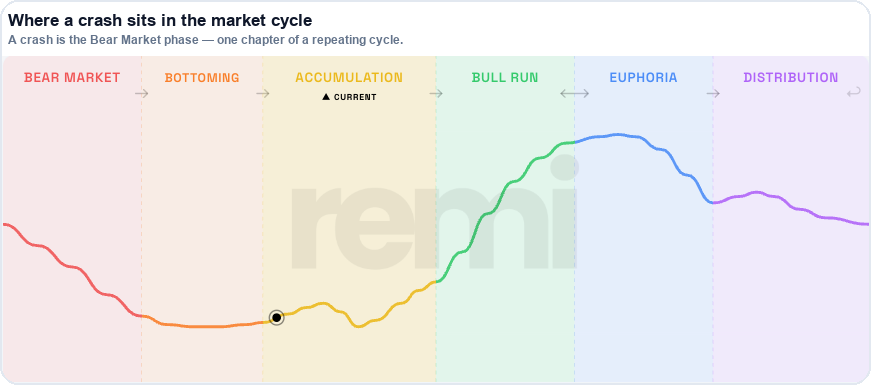
What we can say without a crystal ball: in cycle theory, a crash is the markdown phase, and it's typically followed by a grinding bottom, then a quiet accumulation phase, before anything resembling a recovery or the next bull run. The crash isn't the whole story — it's one chapter. (It's also why a crash makes people ask whether now's a good time to buy — a question nobody can answer for you.) Whether and when the next chapter comes is exactly what nobody can promise you.
Where a crash sits in the market cycle
Every crash is really the same phase of the broader cycle playing out. That's what the REMI Crypto Cycle Index is built to show. Think of it as a super indicator: instead of leaving you to juggle a dozen charts and your own rattled nerves, it melts a range of market indicators into one readable view of the cycle, across six phase labels — Bottoming, Accumulation, Bull Run, Euphoria, Distribution, and Bear Market. A crash is the Bear Market phase in action.
It tracks the market live and updates daily, so the read progresses as the cycle progresses rather than sitting frozen on the day someone published a chart. Positive readings may reflect stronger market conditions; negative readings may reflect weaker or risk-off conditions. It won't tell you to buy, sell, hold, or time anything — it just replaces "why is everything red?!" with "where are we actually in the cycle?"
See which phase the market is in
REMI melts a range of market indicators into one educational read on the cycle, across six phase labels. No hype, no price targets. Set up a free account and REMI can email you when the cycle phase changes — so you can step away from the chart instead of watching it bleed red.
View the Crypto Cycle Index →Educational only. Not a trading signal or a recommendation to buy, sell, or hold.
What to do when you're watching crypto crash
Not advice — just how calmer people tend to think about it. Zoom out to longer timeframes instead of refreshing the chart every ninety seconds. Treat sentiment extremes as context, not commands. Remember that the people who get hurt most in crashes are usually the ones making big decisions in the middle of one, with the part of the brain that also panic-texts an ex. Decide your own risk tolerance on a calm green day, not a red one — and if you're unsure, that's a conversation for a licensed professional, not a Reddit thread.
Common questions
Why is the crypto market crashing today?
On any given day there's usually a specific trigger — a big sale, an ETF outflow, a macro or regulatory headline. But the trigger only causes a crash when the market is already primed with leverage and fragile sentiment. The headline is the spark; the structure is the fuel. For a live read on which cycle phase the market is in, see the REMI Cycle Index.
Is a crypto crash the same as a bear market?
Closely related. The crash is the active falling part of the bear-market phase. Once the crash exhausts itself and a floor forms, the bear market is structurally ending — more on that in is the bear market over?
Will crypto recover after this crash?
Historically the broad market has recovered from past crashes, but that's history, not a guarantee — and individual assets can fail entirely. The timing of past recoveries has only been clear in hindsight, and no one can promise a recovery in advance.
How long do crypto crashes last?
It varies enormously — from a sharp, days-long flush to a grinding, year-plus decline. Past durations don't predict future ones. The crash ends when forced selling exhausts, which is only clearly visible in hindsight.
Not financial advice
REMI is an educational market-intelligence tool. Nothing on this page is investment, financial, legal, or tax advice, and nothing here is a recommendation to buy, sell, or hold any asset. Use REMI as educational market context, not as personalized financial advice. Cryptocurrency is highly volatile and carries significant risk, including the risk of total loss — always do your own research and consider speaking with a licensed professional before making any decision.
Last updated: June 2026 · Cycle Index · Privacy · Terms