
Is Now a Good Time to Buy Bitcoin?
Updated June 2026 · Educational market context, not financial advice
Nobody can tell you whether today is a good day to buy Bitcoin — not us, not a YouTuber, not the guy in your group chat. Historically, the best entry points have only been obvious in hindsight. What you can do is understand what actually matters: your time horizon, your risk tolerance, and roughly where the market sits in its cycle. This is a thinking guide, not a green light.
It's the most-searched question in crypto for a reason — everyone wants someone else to make the call so they don't have to own it. But "is now a good time?" is the wrong question dressed as a smart one. The better question is "do I have a plan I'd be comfortable with whether the price goes up or down from here?" That one you can actually answer.
Required honesty: nothing here is financial advice or a recommendation to buy, sell, or hold — it's educational context for your own research.
Why nobody can tell you the "right" time to buy
Timing the market means being right twice — buying near a low and knowing it was a low. Historically, even professionals with vast resources have struggled to do that consistently, because the bottom is only obvious in hindsight. The same red, scary moment that turns out to be a great entry looks identical to the one that precedes a deeper fall.
So claims like "now is the time" or "wait for the dip" are predictions about an unknowable future, not established facts. The honest position is humility: the precise best moment can't be known in advance. That's not a dodge; it's just how markets work.
What actually matters more than timing
A common educational framing is to look less at when and more at the factors that shape how a purchase would feel either way. The things people often point to as mattering more than picking the perfect day:
- Your time horizon. Money you might need next month behaves very differently from money you can leave alone for years. Short horizons and a volatile asset are a stressful combination.
- Your risk tolerance — honestly assessed. Crypto can fall 50%+ and has gone to zero for individual coins. If a drop like that would wreck your finances or your sleep, that's the most important fact about your situation, not the current price.
- Whether the money is needed for essential expenses. A commonly discussed risk consideration is the difference between money set aside for speculation and money needed for rent, bills, or an emergency fund.
- Independent research and reflection. People often contrast reactive, in-the-moment decisions with ones made after their own research — for example, a quiet Sunday versus 2am during a green or red candle.
Notice none of those is a price prediction. They're about you — and they're things you can actually know, unlike the future.
One concept people discuss instead of timing
One idea that comes up a lot in this debate is dollar-cost averaging (DCA): investing a fixed amount on a regular schedule regardless of price, rather than trying to call the top or bottom. It's described here purely as a widely-discussed concept — not a recommendation, and not something we're suggesting you do.
Whether any approach like that fits you depends entirely on your goals and risk tolerance, which is a conversation for you and a licensed professional — not a blog. We mention it only to make a narrow point: "what is my strategy?" is a more answerable question than "is today the perfect day?" — the first is something you can actually plan; the second has never been reliably answerable in advance.
How the cycle phase gives you context (not a signal)
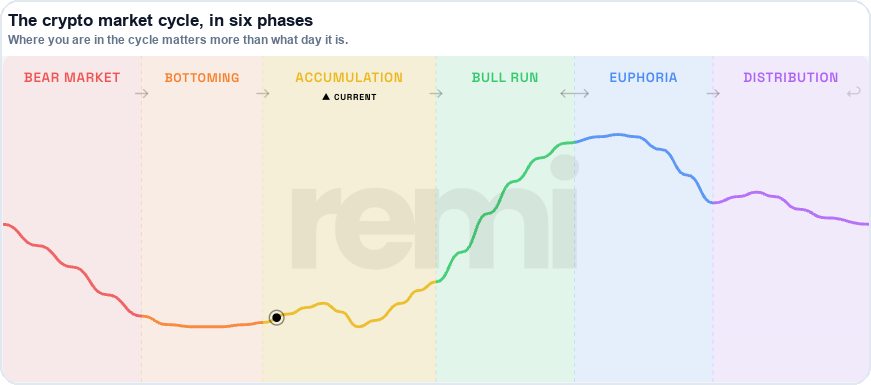
A cycle view offers educational context for understanding broader market conditions — it should not be used to decide whether or when to buy. It reframes "is today the day?" into "where are we in the bigger picture?", which is a question about the environment, not a judgment about whether any purchase is suitable for you. On its own it can't tell you that. It's the same reason where the market sits in the cycle is broader context than the exact price on any given day.
That's what the REMI Crypto Cycle Index is built to show. Think of it as a super indicator: instead of leaving you to juggle a dozen charts and your own FOMO, it melts a range of market indicators into one readable view of the cycle, across six phase labels — Bottoming, Accumulation, Bull Run, Euphoria, Distribution, and Bear Market. It tracks the market live and updates daily. Positive readings may reflect stronger market conditions; negative readings may reflect weaker or risk-off conditions. It will not tell you to buy, sell, hold, or time anything — it just presents cycle context for your own research, so the bigger picture is easier to understand without treating it as an instruction.
See which phase the market is in
Instead of guessing whether today is "the" day, see where the market sits in its cycle. REMI melts a range of market indicators into one educational read, across six phase labels. No hype, no price targets, no "buy now."
View the Crypto Cycle Index →Educational only. Not a trading signal or a recommendation to buy, sell, or hold.
When "is it a good time to buy?" is the wrong question
A few honest red flags that the question itself has gone sideways — none of these is advice, just patterns worth noticing in yourself:
- You're asking because of FOMO. If the urge to buy spiked because the price is ripping and you're scared of missing out, that's the feeling talking, not a plan.
- You're asking because of panic. The mirror image — wanting to buy a crash to "average down" with money you didn't plan to spend is how a bad week becomes a worse one.
- You'd be using money you can't afford to lose. If the answer to "is now a good time?" depends on the price not falling, the honest answer is that the timing was never the real issue.
So, how do people actually decide?
Not advice — just how some market participants describe their own approach. Some make strategy decisions on a quiet day rather than in the middle of a green or red one. Some get clear on their time horizon and what they could afford to lose before looking at the price. Some treat the cycle as context rather than a command. None of that is a recommendation for you — it's just a description of how people talk about it. If real money is on the line and you're unsure, that's exactly what a licensed financial professional is for — not a blog, not a forum, and not us. We can describe a way of thinking; the decision is yours alone.
Common questions
Is now a good time to buy Bitcoin?
Nobody can answer that for you, including us — the perfect moment is unknowable in advance. What's answerable is whether you have a plan that fits your time horizon and risk tolerance. A cycle view can give you context, but it's not a buy signal.
Should I wait for a dip to buy Bitcoin?
"Wait for the dip" assumes you'll recognize the dip and that it won't keep dipping — neither is knowable in advance. Dollar-cost averaging is often discussed as a general concept in this debate, but this page is not recommending it; whether it suits anyone is a question for that person and a licensed professional.
What's the safest way to buy Bitcoin?
There is no "safe" way to buy a highly volatile asset — it carries significant risk, including total loss. Commonly discussed risk topics include volatility, the possibility of total loss, whether the money is needed for essential expenses, and the value of independent research. That's general education, not a safety guarantee or a recommendation.
Does the cycle tell me when to buy?
No. The REMI Cycle Index shows which phase the market resembles as educational context. It does not tell you to buy, sell, hold, or time anything — that decision is always yours.
Not financial advice
REMI is an educational market-intelligence tool. Nothing on this page is investment, financial, legal, or tax advice, and nothing here is a recommendation to buy, sell, or hold any asset. Use REMI as educational market context, not as personalized financial advice. Cryptocurrency is highly volatile and carries significant risk, including the risk of total loss — always do your own research and consider speaking with a licensed professional before making any decision.
Last updated: June 2026 · Cycle Index · Privacy · Terms