
Is the Bear Market Over?
Updated June 2026 · Educational market context, not financial advice
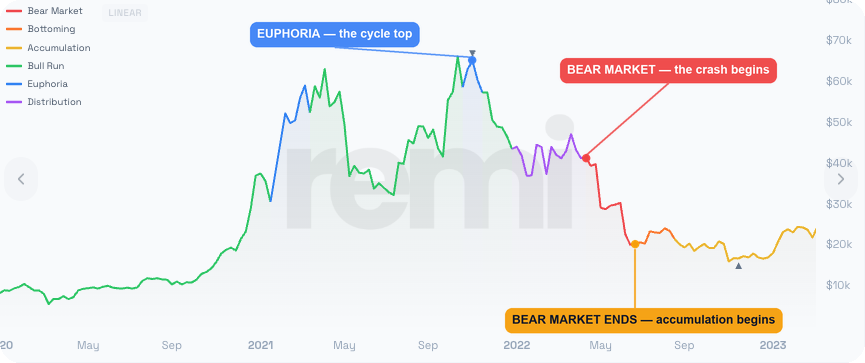
A "bear market" is the part where things are actively crashing — not the quiet bottom where everyone's miserable. Once the crash exhausts itself and a floor starts forming, the bear market is technically over and a new phase has begun. So if you're asking this while the dust is settling, the honest answer is often: it may already be behind you — you just can't feel it yet.
If you found this page, the chart is probably red-ish, your portfolio has taken a beating, and somewhere a headline used the word "bloodbath." And here's where 99% of people get it wrong — including a lot of people who sound very confident on your timeline: they don't actually know what a bear market is. They smear the label across the entire miserable stretch — the crash and the grim, sideways bottom that comes after — and call the whole thing "the bear market."
That one misunderstanding is quietly expensive. It's why people stay frozen in fear long after the actual danger has passed, why they're still bracing for impact when the crash already ended, and why "is the bear market over?" feels impossible to answer — they're using one word for two completely different phases. Get the definition right and the question gets a lot clearer.
Quick honesty up front: nothing here is financial advice — it's educational context for your own research.
What a crypto bear market actually is (and isn't)
A bear market is the crash. It's the markdown phase: price actively falling, lower highs and lower lows, optimism draining out, and the slow conversion of "diamond hands" into people who quietly stop checking the price. The defining feature is motion — things are going down, and it hurts.
Here's the misconception that traps people: the quiet, depressing bottom is NOT the bear market. When the crash finally exhausts itself in a wave of capitulation (the get-me-out, sell-at-any-price flush) and price stops falling and starts grinding sideways along a floor — that's a different phase. In REMI's six-phase cycle, the sequence is:
- Bear Market — the crash. Active markdown, falling price, real pain.
- Bottoming — capitulation hits, selling exhausts, a floor starts to form. This is where the bear market actually ends.
- Accumulation — boring, sideways, range-bound. Patient money quietly builds while everyone else is too burned out to look. (This is a phase in its own right — not "still the bear market.")
- Then Bull Run → Euphoria → Distribution, and eventually back to a bear market, and the wheel turns again.
So when someone says "we're at the bottom finding a floor, still deep in the bear market" — and almost everyone says exactly this — they are, structurally, wrong. Finding a floor is Bottoming, headed into Accumulation. The bear market, the actual crashing part, is already over. This is the single most common mistake in reading a crypto cycle: people feel the pain of the bottom and assume the danger is still in front of them, when the structure says the worst of the move is already behind them. It doesn't feel over — because the mood at a bottom is identical to the mood at the worst of the crash. That's the trap.
So how do you know the crash is actually done?
The honest answer: the exact bottom is only confirmable after it's behind you. Historically, no widely-followed method has reliably pinpointed the low in advance. But you don't need the precise tick — you need to spot the handoff from Bear Market into Bottoming, which is a cluster of conditions, not a single bell:
- Capitulation fires. A violent, high-volume, get-me-out flush — the kind of day where it feels like everyone sold at once. That panic is often the crash spending the last of its energy.
- The new lows stop coming. Price stops falling even while the headlines are still ugly. The downtrend's defining feature — lower lows — quietly goes missing.
- Lower lows become higher lows. The single most important structural shift, the mirror image of a market top. The floor starts holding.
- Panic curdles into boredom. The crowd stops caring. Volume dries up, crypto vanishes from the news, the group chat goes quiet. Accumulation is famously boring — which is exactly why most people miss that the bear market already ended.

Signs the crash isn't done yet
The flip side: sometimes what looks like the floor is just a pause on the way down. A sharp rally inside an ongoing crash isn't the turn — traders have a grim nickname for the version that fails: a dead-cat bounce. The bear market is still running if:
- The downtrend structure is intact. On the higher timeframes, price is still printing lower highs. A 30% rally feels euphoric, but if it stalls below the last lower high and rolls over, the crash hasn't structurally broken — you're still in Bear Market, not Bottoming.
- The bounce came too fast, on hope. Real bottoms are built on boredom and exhaustion, not on a frantic V-shaped rip while everyone's still emotional. Hope-fueled rallies inside downtrends have a long history of failing.
- Nobody has actually given up. Capitulation kills the reflex to buy every dip. If the crowd is still confidently buying and calling bottoms, the washout — and the bear market — may not be finished.
Notice these are the inverse of the signs a bull run is topping — because the cycle rhymes. For the other half of this picture, see our companion piece on whether the bull run is over.
This is exactly why the REMI Cycle Index exists
So why do 99% of people get this wrong? It's not stupidity — it's that at a bottom, your emotions are lying to you. The crash has ended, the bear market is structurally over, you've quietly slipped into Bottoming or Accumulation — but it feels identical to the worst of the crash. So people sit in fear, miss the phase change entirely, and tell themselves "we're still in the bear market" while the cycle has already moved on without them. The misread isn't a data problem. It's an emotion problem — and emotion is the one thing a chart full of red can't help you with.
That's the whole point of the REMI Crypto Cycle Index: it takes the emotion out and shows you the phase you're actually in. Think of it as a super indicator — instead of leaving you to juggle a dozen charts and your own rattled nerves, it melts a range of market indicators into one readable view of the cycle, across six clearly labeled phases: Bear Market, Bottoming, Accumulation, Bull Run, Euphoria, and Distribution. When the index reads "Accumulation," it's telling you the crash is behind you — even on the days it doesn't feel that way.
It tracks the market live and updates daily, so the read progresses as the cycle progresses rather than sitting frozen on the day someone published a chart. Positive readings may reflect stronger market conditions; negative readings may reflect weaker or risk-off conditions. It won't tell you to buy, sell, hold, or time anything — it just replaces "how do I feel right now?" with "where are we actually in the cycle?"
See which phase the market is in
REMI melts a range of market indicators into one educational read on the cycle, across six phase labels. No hype, no price targets. Set up a free account and REMI can email you when the cycle phase changes — so you can step away from the chart instead of watching it bleed red.
View the Crypto Cycle Index →Educational only. Not a trading signal or a recommendation to buy, sell, or hold.
What history says about how long bear markets last
People want a number here, so let's be honest about it: past crypto bear markets have varied wildly in length, from a handful of months to well over a year, and past patterns don't predict future results. Some analyses line cycle phases up against Bitcoin's halving schedule; others argue ETFs and institutional money have stretched or broken the old four-year rhythm entirely. Both camps are mostly reasoning backward from charts. The useful takeaway isn't a date — it's that the crash ends when selling exhausts, not when the calendar says so, and the handoff into Bottoming is usually only obvious in hindsight.
How to read all this without losing your mind
The people who get chewed up by bear markets mostly aren't the ones with bad spreadsheets. They're the ones refreshing the chart at 2am, making decisions with the part of the brain that also panic-texts an ex. A calmer, more educational approach tends to look like this: zoom out to longer timeframes instead of inhaling five-minute candles, treat sentiment extremes as context rather than commands, and decide your own risk tolerance on a boring green day, not in the middle of a red one. A cycle framework is just a structured way to keep some perspective while everyone else loses theirs.
Common questions
Is the crypto bear market over right now?
Remember the distinction: the bear market is the crash. Once capitulation hits and a floor forms, the bear market is structurally over and you've moved into Bottoming, then Accumulation — even though it still feels grim. So "is it over?" often depends on whether the crash has actually exhausted itself, which is only fully confirmable in hindsight. For a live, educational read on which phase the market is in today, the REMI Cycle Index maps current conditions onto six phases.
Isn't a bear market the same as the bottom?
No — and this is the most common mix-up. The bear market is the active crash (price falling). The bottom is what comes after, once selling exhausts and price grinds sideways along a floor — that's Bottoming, heading into Accumulation. They feel the same emotionally, but they're different phases, which is exactly why an emotion-free read of the cycle is so useful.
How long do crypto bear markets usually last?
Historically they've ranged from several months to well over a year, but the timing has varied a lot and past patterns don't predict future results. Anyone giving you a confident exact date is guessing.
What comes after a crypto bear market?
In cycle theory, a bear market gives way to bottoming conditions, then accumulation, then potentially a new bull run — though no recovery is guaranteed for any asset or timeframe. You can see all six phase labels on the REMI Cycle Index.
Not financial advice
REMI is an educational market-intelligence tool. Nothing on this page is investment, financial, legal, or tax advice, and nothing here is a recommendation to buy, sell, or hold any asset. Use REMI as educational market context, not as personalized financial advice. Cryptocurrency is highly volatile and carries significant risk, including the risk of total loss — always do your own research and consider speaking with a licensed professional before making any decision.
Photo by Jakub Zerdzicki on Pexels.
Last updated: June 2026 · Cycle Index · Privacy · Terms