
When Is the Next Crypto Bull Run?
Updated June 2026 · Educational market context, not financial advice

Nobody can give you a reliable date for the next crypto bull run — historically, the start of a run has only been clear in hindsight. What you can learn is what has tended to come before past bull runs, why the famous "four-year cycle" timing is hotly debated, and how to read where the market sits now — so you're watching for the turn instead of refreshing a countdown that doesn't exist.
"When's the next bull run?" is the hope-fueled twin of "is the bull run over?" — same impossible wish for certainty, opposite emotion. Everyone wants a calendar date so they can relax and feel early. But a bull run doesn't start on a schedule; it starts when conditions quietly line up, and that's only obvious once it's already underway.
Quick honesty up front: nothing here is financial advice — it's educational context for your own research.
What is a crypto bull run, exactly?
A crypto bull run is the markup phase of the cycle: a sustained uptrend of higher highs and higher lows, rising optimism, and the slow return of people who swore they were "done with crypto" six months earlier. It's not a single green day — it's a structural shift where the trend flips from down or sideways to convincingly up, and the mood follows.
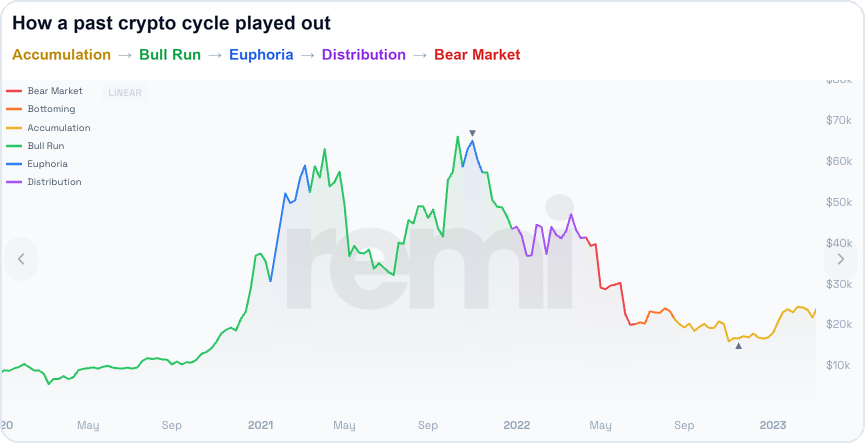
In the six-phase cycle, a bull run comes after the bear market has ended and the market has spent time bottoming and accumulating. So "when's the next bull run?" is really asking "how far along is the boring part before the exciting part?" — which is a much more answerable question than a date.
Why nobody can predict the date
Calling the start of a bull run is just as impossible as calling the top — you have to be right about both direction and timing, in advance, while the data is still ambiguous. The quiet accumulation phase that precedes a run looks, in real time, identical to "crypto is dead and boring forever." One of those turns into a bull run; the other drags on. They feel the same while you're in them.
So a confident date ("the bull run starts in Q1!") is best read as a guess, not a forecast — the exact start is unknowable in advance. But the conditions that have historically preceded past runs are something you can actually learn to recognize.
What historically comes before a bull run
No single signal rings a bell at the bottom of a cycle, and history doesn't repeat on command. But a cluster of conditions has tended to show up before past runs began — described here as historical pattern, not a forecast:
- The bear market has actually ended. The crash exhausts itself, selling dries up, and price stops making new lows — the handoff into bottoming. (More on that in is the bear market over?)
- A long, boring accumulation base. Past runs have tended to build out of a quiet, sideways, nobody-cares stretch — not straight off a crash. Boredom, historically, has done a lot of the groundwork.
- Sentiment has fully washed out. The crowd that swore off crypto, the dead group chats, the "is it even worth it" posts. Maximum disinterest has often clustered near the start of past recoveries — though sentiment alone is never a timing tool.
- Higher lows start forming. The structural tell: the market quietly stops making fresh lows and begins holding higher ones, the mirror image of a topping pattern.
The four-year cycle and halving timing
You'll hear a lot about Bitcoin's four-year cycle and the halving (the roughly-every-four-years event that cuts the rate of new Bitcoin issuance). As a historical pattern, past bull runs have often gathered momentum in the roughly 12–18 months after a halving. Some people treat that as a rough map of where in the cycle the market might be.
Big caveat, and it's a real debate: plenty of analysts argue the old four-year rhythm has been stretched or broken by ETFs, institutional money, and a more mature market — so the historical timing may not hold going forward. Treat the four-year cycle as one lens among many, not a countdown clock. Past patterns don't predict future results.
How the cycle tells you where you are (not when)
Here's the reframe: you can't know when the next bull run starts, but you can get a read on where in the cycle the market currently sits — and that's far more useful than a guessed date. Knowing whether the market looks like it's still in a bear market versus a quiet accumulation base is context for your own research, not a starting gun — and it's the same context behind questions like whether it's a good time to buy or why crypto is crashing in the first place.
That's what the REMI Crypto Cycle Index is built to show. Think of it as a super indicator: instead of leaving you to juggle a dozen charts and a countdown that doesn't exist, it melts a range of market indicators into one readable view of the cycle, across six phase labels — Bottoming, Accumulation, Bull Run, Euphoria, Distribution, and Bear Market. It tracks the market live and updates daily. Positive readings may reflect stronger market conditions; negative readings may reflect weaker or risk-off conditions. It will not tell you to buy, sell, hold, or time anything — it just shows which phase current conditions resemble, so you're watching the cycle instead of the calendar.
See which phase the market is in
Instead of guessing a date for the next bull run, see where the market sits in its cycle. REMI melts a range of market indicators into one educational read, across six phase labels. Set up a free account and REMI can email you when the cycle phase changes.
View the Crypto Cycle Index →Educational only. Not a trading signal or a recommendation to buy, sell, or hold.
What to watch instead of guessing a date
Not advice — just a calmer way people describe following the cycle. Some watch the structure (have the lows stopped getting lower?) rather than a calendar. Some treat the four-year cycle as a rough lens, not a deadline. Some use a cycle read as context and get on with their lives instead of refreshing the chart for a starting gun that never fires on schedule. None of that is a recommendation — markets do what they do, and the next run will be obvious mostly in hindsight, same as every one before it.
Common questions
When will the next crypto bull run start?
Nobody can give a reliable date — the start of a bull run is only clear in hindsight. What's knowable is which phase the market currently resembles. A cycle view gives you that context, not a countdown.
Does the Bitcoin halving cause a bull run?
Historically, past bull runs have often built momentum in the 12–18 months after a halving, but that's a pattern, not a guarantee — and many argue ETFs and institutional flows may be changing the old rhythm. Treat it as context, not a prediction.
Is the four-year crypto cycle still valid?
It's actively debated. Some say the broad phases still apply; others argue the timing has been stretched or broken by a more mature market. REMI focuses on reading current conditions rather than betting on a fixed calendar.
How do I know if a bull run is starting?
You usually don't, in real time — that's the honest answer. Structurally, the market stops making lower lows and starts making higher ones, but that's only confirmable after the fact. The REMI Cycle Index shows which phase conditions resemble as educational context, not a buy or timing signal.
Not financial advice
REMI is an educational market-intelligence tool. Nothing on this page is investment, financial, legal, or tax advice, and nothing here is a recommendation to buy, sell, or hold any asset. Use REMI as educational market context, not as personalized financial advice. Cryptocurrency is highly volatile and carries significant risk, including the risk of total loss — always do your own research and consider speaking with a licensed professional before making any decision.
Last updated: June 2026 · Cycle Index · Privacy · Terms